Some time ago I had the following shower thought: "the Speed of Light is pretty slow"
How i got there:
The closest major galaxy to the Milky Way is Andromeda, and is 2.5 million! light-years away. And this is the CLOSEST galaxy, the universe is extremely big.
Of course that as you get closer to C, the traveling object will experience time dilation (relative to observer), so the time passed will be less. At 99.999% C, the traveler would take ~11,000 years to arrive to Andromeda.
So again, even at 99.999% C, 11K years seems like a LONG time to reach even the closest galaxy.
My reasoning was: the speed of light is pretty damn slow.
But then I realized: no, it's not the speed of light that is slow, is my frame of reference.
For us humans, 11,000 years seems like A LONG time, but for the universe is not that long.
The universe's age is estimated to be 13.8 billion years. 11,000 years is 0.0000007971 of the age of the universe.
An average human lives 70 years, 0.0000007971 of that lifespan is approximately ~0.4 hours, or 29 minutes, so it's not that bad.
At 1G constant acceleration reaching Andromeda would take ~15 years, or ~29 years if we also need to decelerate at the same 1G rate to not just whoosh by.
The furthest known galaxy is MoM-z14, which would take ~47 years to reach.
But unlike Andromeda, MoM-z14 is accelerating away from us, or more precisely, the space between us and MoM-z14 is expanding. It's "receding" at 726,000 km/s (= 2.4 times the speed of light). And still accelerating. Because of these, even the magical constant 1G accelerating spaceship can never reach it, not even in 1 Billion years.
There's a diagram for how long it takes a 'light-hugger' ship to travel various distances at 1-G acceleration. Shiptime is on the left, earth time is on the right.
https://en.wikipedia.org/wiki/File:Roundtriptimes.png
This is a really interesting video that explores this topic, pointing out that at near light speeds, the entire universe becomes accessible in a single human lifetime.
Yeah, once you reach a certain speed, even colliding with a fleck of dust can obliterate a ship.
Colliding with a single 0.3 mg grain of salt at 20% of the speed of light creates an impact with 560 MJ of energy, equivalent to 130 kg of TNT, over 8 times the nuclear bomb dropped on Hiroshima.
Even a tiny speck of dust, half a microgram, is equivalent to a hand grenade when hit at 20% the speed of light.
You wouldn't be able to even escape the solar system before your shields were devoured. If you accelerated at 1G constantly, you'd be going 3.5% of the speed of light by the time you reached Pluto's orbit. Space dust particles are already hitting you like nuclear bombs at that speed.
Then I guess you will need millions tones of perfect mass to light converter like Astrophage just to get to the neighbor. The universe is simply too big to comprehend.
There was a bit in the series "The Expanse" about a what's called "Epstein Drive" where some guy invents a propulsion tech based on fusion and he losts control of his aircraft under an ever-increasing acceleration. After some minutes, his body gets crushed under its own weight before he could reach the controls and slow the spaceship down.
Yeah, certainly a reason to have failsafe timers and dead-man switches when testing new things.
While I did read The Expanse, when I think of that class of dangers, what pops to my mind is an old short story Neutron Star (1966) [0]. A financially desperate pilot is hired to discover what killed some researchers while leaving the indestructible starship hull intact... and the thrusters off.
Thanks for the Niven reference. Neutron Star was a fun read. I'm currently working through a collection of 80s SF shorts[0]. It's an entertaining lens into the narratives mores of the time, and or own in contrast.
> failsafe timers and dead-man switches when testing new things.
Aircraft and spacecraft are more than anything, mass constrained. Such failsafes are welcome in software, but neither the bleeding-edge engineers not even the test pilots would support adding failsafe mass if it would affect the tests.
there was an interesting retcon of that story in one of niven's later works, where it was pointed out that any spacefaring race would know instantly what killed him. it was just better PR to pretend that it was a huge mystery, and that their hull wasn't vulnerable to some stupidly obvious danger but rather to something no one could have foreseen.
Relativity is weird. If you keep accelerating, at some point the objects stop accelerating toward you faster but the distances get shorter.
To an outside observer, the trip might have taken you millions or billions of years while to you it was only ten or twenty.
It’s helpful to think about the limit. To light, which travels at the speed of light, it arrives at your retina the exact moment it was created in the core of the sun. From our perspective, it took almost a million years (about a million years to make it from the core to the convective region, then another few minutes to travel from there to Earth).
Nope! Far, far longer. I don’t know the specifics that the GP used but Andromeda is about 2,500,000ly away. An observer on Earth must perceive you as taking more than 2,500,000 years to get there, as you would have to have exceeded the speed of light to arrive any sooner.
At 1g of constant acceleration you can reach Andromeda in just under 15 years of experienced time. An observer on Earth will perceive you as having taken a hair over 2,500,000 years to get there. You can get there arbitrarily quickly; at 10g it would take a 1 year 9 months. But an external observer on either planet will see you taking closer and closer to 2,500,000 years to make it the full distance.
> Of course that as you get closer to C, the traveling object will experience time dilation (relative to observer), so the time passed will be less. At 99.999% C, the traveler would take ~11,000 years to arrive to Andromeda.
When you say constant 1g acceleration, do you mean acceleration well past the speed of light? I thought we were talking about all speeds less than the speed of light.
You can accelerate constantly at 1g without ever reaching the speed of light. A constant acceleration takes you from non-relativistic speeds to 0.1c, then to 0.9c, then to 0.999c, then to 0.9999c, , and so on, without ever reaching 1c (impossible if you have mass) -- but it takes increasingly more energy to accelerate.
The Lorentz factor, which governs time dilation and length contraction, is calculated as (1 / sqrt(1 - v^2 / c^2)), where v is the relative velocity of the object and c is the speed of light. You can replace (v^2 / c^2) with the factor beta^2, where beta is the ratio of v to c, e.g. 0.99999 in this case. Since (1 / sqrt (1 - 0.999...)) grows without bound in the limit as beta approaches (but doesn't reach) 1, if you keep accelerating, the time dilation keeps getting larger, without limits. It just takes a LOT of energy to do so.
I was still at a loss for the answer to how it could take 11k vs 28 years or so. I asked AI. lol
The thing I didn’t realize is the massive difference between 99.999% vs 99.9999% of the speed of light. I took 99.999% to mean "effectively the speed of light.” Relativity is weird.
yeah but its statistical luck, a few photons keep winning the roulette wheel and pop out very quickly; and a few unlucky ones are still rattling around in there from year 1! it's more like winning a raffle than waiting in a queue
On YT there is a video of a flight through the solar system at the speed of light starting at the Sun. It's a pretty boring video. You see very little movement and change over time. After 8 minutes Earth slowly passes by. After 44 minutes you reach Jupiter and the video ends.
If The Moon Were Only 1 Pixel (A tediously accurate scale model of the solar system) https://www.joshworth.com/dev/pixelspace/pixelspace_solarsys... has a button at the bottom right for 'C' which scrolls to the right at the speed of light on that scale.
https://thinkzone.wlonk.com/SS/SolarSystemModel.php?scale=10... lets you make scale model calculations (useful if you're building one). The default model scale has the speed of light at 67.06 mi/h (107.9 km/h). This puts Earth out at 14.16 miles and Alpha Centauri at 2,581,000 miles away.
I personally like the "Sun is 5 inches" scale because that puts the speed of light at 323.1 ft/h (10x garden snail speed) which is 1.46 miles/day... because that puts Alpha Centauri at 2,354 miles away... which is a conceivable distance.
If you go to a scale of the sun being 500 inches (about 110000000) and the speed of light is 6 mph, Alpha Centauri is 234,600 miles away - the distance to the moon. It also lists the scale distance to the center of the Milky Way 1,327,000,000 miles) and Andromeda (137,400,000,000 miles) which are in the unconceivable range.
In Australia there is a scale model of the Solar System where the sun is the main dome of Siding Springs observatory and the planets are on billboards at scale size and distance. Pluto is several hundred kilometres away (and the size of a tennis ball on the billboard)
This discussion has made me wonder what it would look like to have a different scale where the distances are based on the “speed limit” (which is mostly 100km/hr)…so that earth, for example, would be 8min from the Sun. Neptune or Pluto would be 4 - 7 hours away.
It would still fit in Australia but be significantly larger.
The 10,000,000,000 (1 : 10B) scale would be kind of neat for Australia. Six soccer fields in Sydney and you've got the Sun to Pluto. One soccer field holds the Sun to Jupiter.... Alpha Centauri is in Perth. The speed of light is 100 meters / hour.
Does this take relativistic effects into account? The video I mentioned doesn't. Near the speed of light your surrounding looks like sped up and the distance to your target is clinched. Your own time runs slower in comparison and the distance is shorter. So theoretically you're able to reach the destination millions of LY away in your lifetime.
Edit: I now watched the animation. It's exactly the same as the YT video. Speed of light is very, very slow.
Roman lowercase c is the metric prefix centi-. Roman uppercase C is the metric unit coulomb.
Italic uppercase C has various uses such as: a variable denoting capacitance in electrical engineering; an undetermined constant of integration in calculus.
The OTHER effect of time dilation that isn't being mentioned: the rest of the universe is not accelerating with you, so it doesn't experience time dilation.
Along your trip you will see stars turn red, sometimes flashing white and blinking out, but sometimes just fading away.
Your civilization will without a doubt go extinct.
If you are exceedingly lucky, you may see other civilizations of other species arise... but you'd need very high energy receivers in front of you, or deep infrared receivers behind, and of course be staring at the right place to see the signs.
You may eventually begin to notice the revolving motion of galaxies. After that, if you continue, you'll see galaxies collide. By then your planet will have been dead for longer than it was a planet when you left it.
> "the Speed of Light is pretty slow"
> How i got there:
> The closest major galaxy to the Milky Way is Andromeda, and is 2.5 million! light-years away.
The speed of light is high. It's just that the universe has expanded into an unimaginably large area by now.
There’s sci fi novels that deal with it in just these terms. Like some folks with head out on a .99c acceleration ship and be like “okay we’ll be there in fifteen thousand years (original reference frame time)” and that’s just the scale at which the story unfolds. You just accept that when you leave on these trips that if you ever come back now it’s tens of thousands of years in the future there. Nbd
Yeah, it is and the math get's really counterintuitive to grasp since humans (at least me) have trouble thinking in exponential terms.
If you accelerate at 1g constantly for 1y you travel 0.5 light years. You do that for 10.5 years and you reach the center of the milky way. You do that for another 4 (~14 total) years and you are in the Andromeda galaxy, and you do that for another 10 years (~24 years total) and you reach what today is considered the edge of the observable universe.
By the time you get there you are basically traveling at a rounding error from C.
We can't do it with any rocket-like propulsive technology. By the time you get anywhere close to c the front of your spacecraft is being abraded into nothing by interstellar gas, larger particles of dust will kill you, and colliding with anything bigger creates an explosion that can be seen for light years. You need to be flying a large asteroid to even think about surviving it - you still won't for long, but you will have time to think about it - and the energy requirements are wildly impractical.
Magic warp bubble tech is the bare minimum, and we're nowhere close to inventing that.
Sadly there is no realistic approach to get there (even assuming fantasy-levels of technology).
Chemical rockets are currently the only thing that allow sustaining such accelerations briefly for human-size payloads, but the low exhaust velocity and exponential reaction mass requirement make sustaining it for days/months/years completely impossible.
You'd have to supply the energy externally (i.e. some sort of beam propulsion), but getting any significant fraction of g out of such a system (with human-sized payloads) seems unlikely within the next centuries, especially as the distance increases.
> You'd have to supply the energy externally (i.e. some sort of beam propulsion), but getting any significant fraction of g out of such a system (with human-sized payloads) seems unlikely within the next centuries, especially as the distance increases.
Or some form of ram scope, plenty of H everywhere, but those also have the issue of you collecting things while going at relativistic speeds.
We can easily accelerate past 1g... 1g is just chosen for human comfort, but running any rocket engine continuously for a year requires an impossible amount of fuel.
Not with current technology. That was kind of the physics “trick” in the book ‘Project Hail Mary’, where the astrophage provided enough energy and propulsion to be able to sustain 1G of acceleration.
We need a massive rocket to escape the earths gravity (1g). That takes us minutes and a crap ton of fuel. The issue is to keep doing that with fuel and oxidiser constantly for 1, 2 or 10 or 25 years is a monumental amount of energy, which is a monumental amount of weight, which is a monumental amount of volume... Also you also need the exact same amount of fuel to stop again.... So yeah ... We don't got it yet
It's hard to accelerate at or beyond 1G for very long with current technology. Roughly speaking, the rocket runs out of fuel soon. Packing more fuel makes the rocket heavier, meaning diminishing returns when using the fuel. The mass required grows exponentially. See "The tyranny of the rocket equation"
People always say that about speed of light stuff, but I don’t get it. Do you have any more examples of counterintuitive math?
Because what you’re describing is basically the equivalent to compound interest in finance. (e.g. investing $100 at 10% interest over 10 years results in $260)
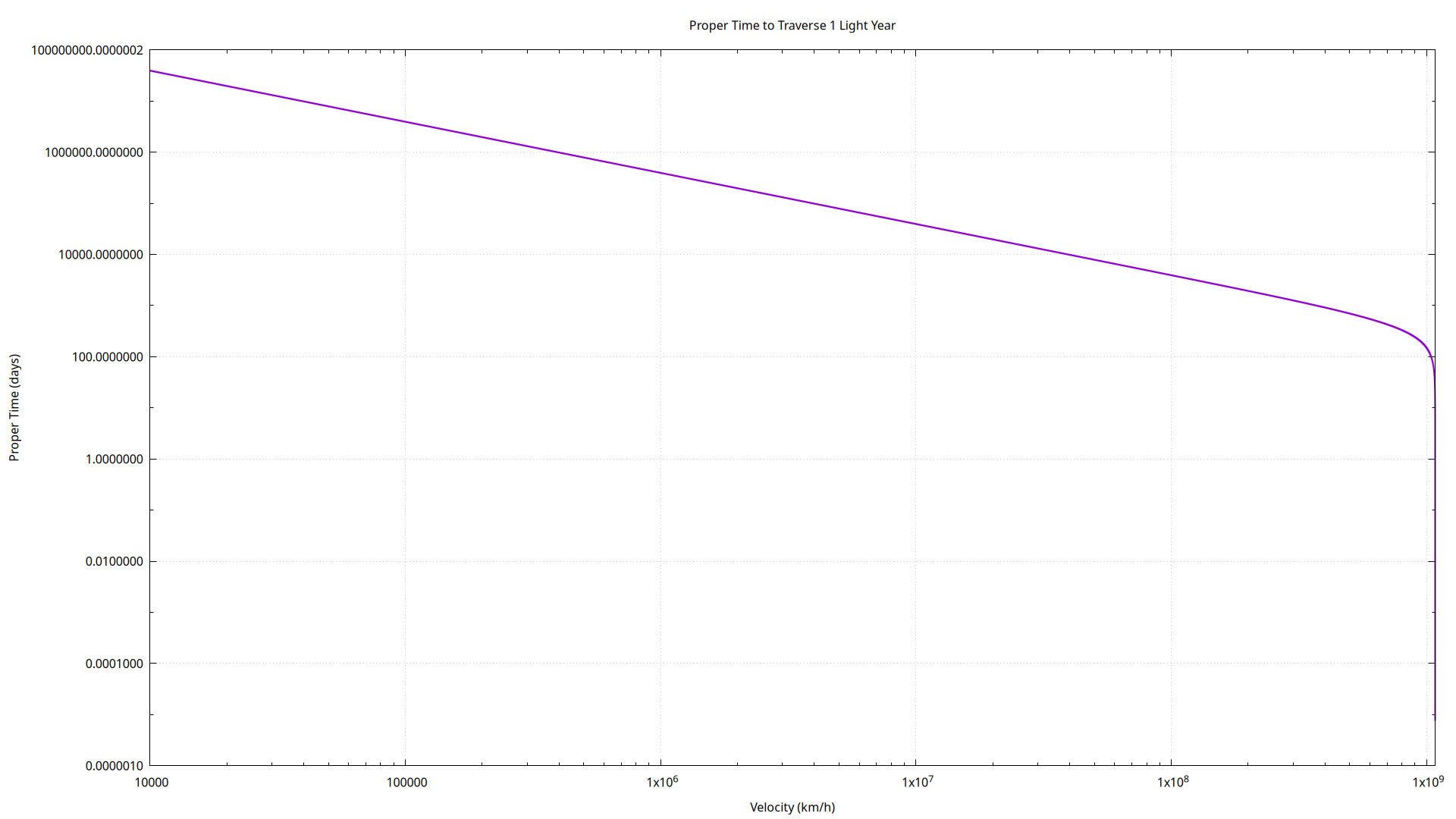
The proper time (that is, the time the traveler measures on a clock) goes to zero very quickly towards the end. Even with both axes plotted logarithmically, it's just a sudden drop at the end towards light speed.
Funnily enough, I use Cloudflare Warp at work, and it breaks my site for what I think are DNS related reasons. Maybe there are some more exotic DNS keys that I need to add.
Or I could go back to IPv4 with dynamic DNS, but that would mean changing domain registrars.
NS record for domains usually can be pointed at someone else than the registrar it's on, just fine(unless DNS infra of either one or both goes down). That's entirely separate to registrar transfer.
It’s the units that make it seem unintuitive. 12 days is roughly 0.032 years, and 17 minutes is likewise 0.000032 years. It’s relative to how we were taught to view smaller lengths of time. Of course you could argue measuring time by the rotation of heavenly bodies is more intuitive than counting on your fingers for the hours in a day and days in a lunar cycle.
Going from a million to a billion isn't some special relationship. It's just * 1000. It's the same as going 11000 or 101000.
I find it frustrating that people seem to think that someone going from 1M to 1B is somehow different to other numerical operations. It's not. It's 1000 times bigger, it's not a huge deal.
> if we add more 9s, is it possible to reduce that number to within a human lifespan?
Yes. At 99.99999999% of c it would take 35 years from the perspective of the traveler. However, an observer on earth will still see it taking 2.5m years.
of course I meant that a human made object traveling at those speeds was theoretical, not time dilation itself. Never thought I'd have to clarify that :)
Relativity fixes that a little, you don't need to go light speed to make it all over the place within your lifetime, it's the observers who sent you off that will never reap the fruits of their effort.
So when we think we're looking at Andromeda today, we're actually seeing Andromeda as it happened 2.5 million years ago. That means someone/something? in Andromeda today, with the ability to see Earth clearly, would see some of our ancestors, like Homo habilis.
I've always wondered, if we end up being able to travel faster than light, we'd technically be able to look into the past depending on how far we go. 1000 light years away and you can see your ancestors on earth.
In some sense yes, but I'm not sure there's enough photons coming from Earth 1000 light years away to see anything, even with a fantastically sensitive telescope. It would be very cool, though.
It doesn't really make a lot of sense to contextualize a velocity with a distance or a time period.
You think those time periods are large because you see a lot of numbers in the units you chose, or because it is much larger than your lifespan. But in the grand scheme a galaxy is nothing but a spec of dust, 10k years a blink of an eye.
There is no other natural velocity that I'm aware of that we could compare it to, but we can say that the speed of light is the fastest there is, so how can it be slow?


How i got there:
The closest major galaxy to the Milky Way is Andromeda, and is 2.5 million! light-years away. And this is the CLOSEST galaxy, the universe is extremely big.
Of course that as you get closer to C, the traveling object will experience time dilation (relative to observer), so the time passed will be less. At 99.999% C, the traveler would take ~11,000 years to arrive to Andromeda.
So again, even at 99.999% C, 11K years seems like a LONG time to reach even the closest galaxy.
My reasoning was: the speed of light is pretty damn slow.
But then I realized: no, it's not the speed of light that is slow, is my frame of reference.
For us humans, 11,000 years seems like A LONG time, but for the universe is not that long.
The universe's age is estimated to be 13.8 billion years. 11,000 years is 0.0000007971 of the age of the universe.
An average human lives 70 years, 0.0000007971 of that lifespan is approximately ~0.4 hours, or 29 minutes, so it's not that bad.
So yeah, frame of reference matters.