"The colours that suddenly flood into the streets of 1910s New York aren’t drawn from the celluloid itself; that information was never captured there."
I've tried to make that point, but I failed many times. Let's try this crowd: We know what colors human faces have, so we can nail those, but coloring a film from, say, the 1950s the way photos from that era looked, is not what the colors back then actually looked like. That's just how camera technology was able to capture them at the time.
So even if you captured color back then, it probably wasn't very realistic.
I don't think people should stop experimenting, I find these videos fascinating and loved Peter Jacksons film, but the past didn't look like you think it did. You're just used to it because all the photographs from the era look a certain way but they were limited.
People didn't look like books either, and didn't look like pottery/statue fragments with the paint washed off, but historians aren't trying to ban that.
There are whole pseudo-intellectual cultures like Objectivists who think that peak of culture are statues with the paint worn off and reading scripts of plays meant to be experienced in live performance.
I can empathasize with the argument to keep the film unmolested and not for snobby reasons like that.
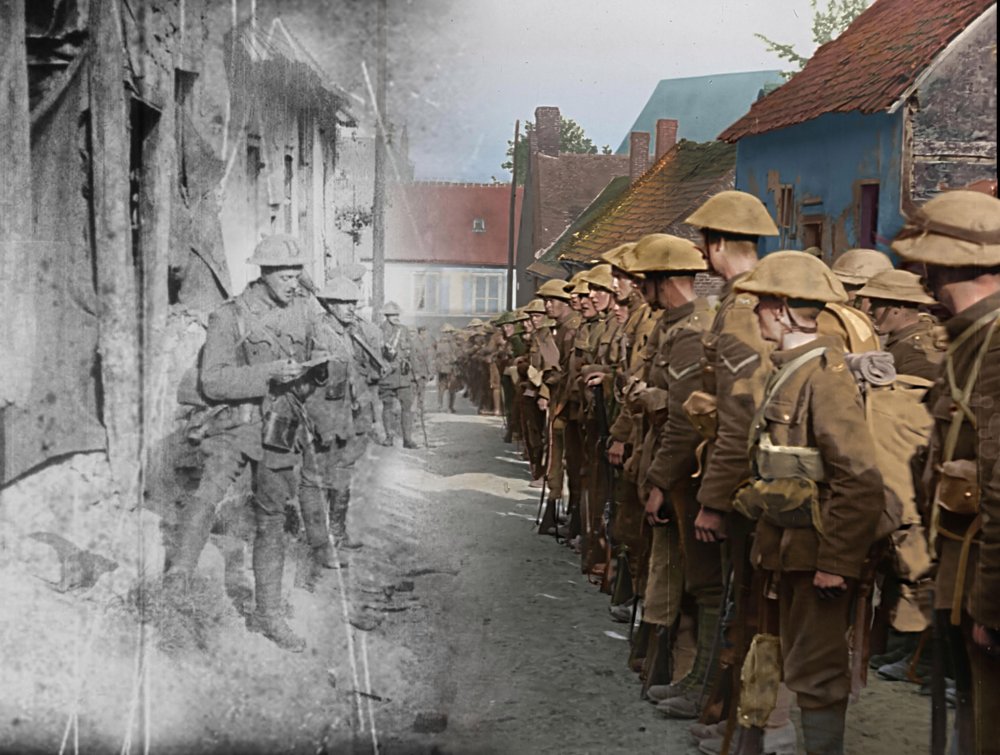
I watched Peter Jackson's "They Shall not Grow Old" which is a collection of restored WW1 footage. Was super hyped going in, but when I saw the footage itself, it just felt off. Like the colors maybe weren't quite right or the motion was super messed up and the whole thing just felt weird and made watching it unenjoyable. I would have prefered to see it in black and white.
My other gripe with the film was that he also loaded it up with sound effects and even added not well mixed VFX like extra explosions and shingles falling off roofs that appear from nowhere (hence why I'm pretty sure they were added in post). Dumping that kind of cheap blockbuster action elements actually felt pretty disrepectful of the soldiers that got filmed. Kind of like they were using them as action figures to tell a story that wasn't quite what happened in reality.
Remember, this footage was created using silent-era film equipment over a hundred years ago. Much of the footage used in the film is borderline unwatchable without the post-processing used: hand-crank cameras meant wildly variable framerate, volatile & unstable early film stock on the frontlines of a war exposed to smoke, dust, heat, cold and gas attacks, over/under-exposed footage caught in the heat of the moment, the list goes on. What I'm saying is, you'd probably complain a lot more if you saw the original footage, or you'd skip most of it as unwatchable in its original form.
Finally, there's an education factor at play. Young people deserve the best possible chance they can get to engage with their history, especially when it offers such a tremendously impactful lesson. And like it or not, I think 90% of people are going to be more engaged, not less, by well-curated, well-produced and respectful recreations of the past. Jackson recorded the SFX using original historical weapons, and colored uniforms using historical examples.
"However, it’s a bizarre sight that greets us, and not just because we lose the top and bottom of each frame. The effect is initially impressive, but that soon wanes. Almost every man has a creamy, peachy skin tone, and the grass in each shot is a warm, yellowy green. The sky is blue. If it weren’t for the daubs of bright red blood, and the bomb craters, this would risk being a unnaturally prettified image of war, with remarkably consistent scenery. These are really incredible images – so homogenising them in this way does them a disservice. It’s not easy either to dispel the thought that all these colours (as well as many of the sounds) are simply guesswork: the colour of hair, blankets, signs and wildflowers having been plucked out of the air." (https://silentlondon.co.uk/2018/10/16/lff-review-they-shall-...)
> Much of the footage used in the film is borderline unwatchable without the post-processing used
That's an interesting commentary on how much technology has advanced, and how we have become so desensitized to it. Consider that when silent films first started, the movie of a train coming right at the camera scared the audience so much that they ran out of the theatre to get out of the way of the train, IIRC.
I agree on your point regarding engaging audiences. Saving Private Ryan and Dunkirk probably taught more people about WW2 than many classes or books.
The difference with moving pictures is that it comes with the implication of photo-realism, while other art forms are self-aware about being representative or expressive rather than being high fidelity simulacra.
I don't mind the colorizations, but to give you some additional ammo for your argument, check out the TV show "The Munsters" and "The Addams Family". If you're not familiar, they're supposed to live in creepy dark houses, and in black and white, the houses do indeed look dark and creepy.
But in reality, those sets were bright pastels. Actual dark walls and floors didn't show up well on film. Which makes me wonder how right we are with some of our other colorizations.
You can google [what did the munsters set actually look like] to get some great examples.
For additional additional ammo look at Star Trek (TOS). A lot of the campy bright colors weren't used to make it look campy but to show up equally well on black and white and color TVs. By using brightly colored uniforms it was obvious even on a B&W TV that Kirk, Spock, and ensign C. Fodder were different and one wasn't coming back from the away mission.
Yes, and we have artifacts (I believe they're called antiques :-)) from that time too that tells us what color clothes were, signs, etc. So we should be able to do alright.
And being such artifacts the means used by historians to reconstruct the past, while they deny others the same rights to interpret it, is quite ironic.
> And being such artifacts the means used by historians to reconstruct the past, while they deny others the same rights to interpret it, is quite ironic.
Maybe that's because those others are more likely to do a bad job, because they lack the training to do a good one. Sort of like how sci-fi filmmakers have taught millions of people that you can hear explosions in space and that lasers make a "zap" sound.
But those artifacts have usually faded with time and exposure to the light, so even those don't show you what the colors actually looked like, unless they have been sealed away from light exposure all this time.
Often you can find a bit of the paint in an overspray area that was covered by some other piece that is well preserved, even if the original paint is totally lost. Start taking off bolts and look at the flecks of paint stuck to the underside of the bolt.
Also, we still have the techniques and materials used to make old paints. New batches can be whipped up (assuming they aren't too toxic) for comparison. Lead based paints obviously are more problematic, but modern technology is really good at replicating paint colors.
You've seen though where a fabric covered couch, color faded over time, will reveal its original color when you roll back the cording covering the zipper or whatever. But I get your point.
Well, technically you're right, but I don't think the pigments in our skin made huge evolutionary advancements in ~100 years. I'd guess people were working more outdoors, but that's it.
So if you were to recolor a film you can take skin colors from today. But an advert, car color or fabric is incredibly difficult, even if you have the original, since the material will have degraded. Even if you repaint it with the original paint it will look different, since the paint will have changed, or if you use new paint the process to manufacture the paint (->led).
which skin colour is a question here as well. There are a lot of variations and I'm not sure that a black and white film is going to contain enough information for you to know. There's a danger of white-washing (or the reverse!) history by mistake.
I think the point is that you simply don’t know in a lot of these videos. They’re random bystanders, not known figures with photographic evidence. So you’re not going to know what to recolour it to, or if it’s even wrong in the first place.
A couple years ago I used deep learning to recolor some old family photos. The net I was using would do it's best guess first, then present a limited set of options for me to choose from when it didn't know what to do. In general, its first pass would immediately make human faces look correct, but leave everything else really desaturated.
I think some of it comes down to the fact that convnets are really good at recognizing human "shapes" (faces, silhouettes, etc) and also the valid color space for human skin tone is pretty constrained if the photo was well lit and you have the luminance value for a grayscale image.
The network was particularly bad at getting the colors of balloons in a picture. I don't know what the real colors were, but the network was trying to tell me 4 of the balloons in a picture were pale yellow and beige while one was a super saturated red.
Another point is that displays can never provide real color representation anyway.
The process flow goes from converting the full spectrum lights in nature into color filtered photons captured on a camera sensor with an artificial color profile, it's own resolution and pixel arrangement, and its own lens specifics, then converted to another limited color palette with another artificial color profile and it's own resolution and pixel arrangement that is the display, in order to simulate the colors of nature as detected by yet another set of filtered detectors with it's own color profile, resolution, neuron arrangement, and lens specifics that is the human eye. There is already no such thing as objective truth when it comes to photography, every step involves heavy interpretation.




I've tried to make that point, but I failed many times. Let's try this crowd: We know what colors human faces have, so we can nail those, but coloring a film from, say, the 1950s the way photos from that era looked, is not what the colors back then actually looked like. That's just how camera technology was able to capture them at the time.
So even if you captured color back then, it probably wasn't very realistic.
I don't think people should stop experimenting, I find these videos fascinating and loved Peter Jacksons film, but the past didn't look like you think it did. You're just used to it because all the photographs from the era look a certain way but they were limited.